Theory vs. Practice
Diagnosis is not the end, but the beginning of practice.
The hidden cost of NGINX and wrk: low RPS, Lost Clients and No-Reply
The Web exists since 1991. 36 years later, G-bench accounts for the Lost Clients (client connection attempts ignored by a server) and the No-Reply errors (clients that don't get server replies). No benchmark reports these errors – yet they are plenty!
wrk -t4 -c200 generates traffic on a 4-line railway (4 concurrent clients), where 200 trains (200 connections) carry N wagons (N requests). The effective parallelism is limited to 4, as the 200 trains (connections) and their wagons (requests) travel serially, that is, one after another.
If, at the exit of a 200-line railway (200 concurrent clients), you have a 4-line train station (a server with 4 concurrent threads), then, without careful planning to avoid concurrency peaks, you get an horrible traffic jam:
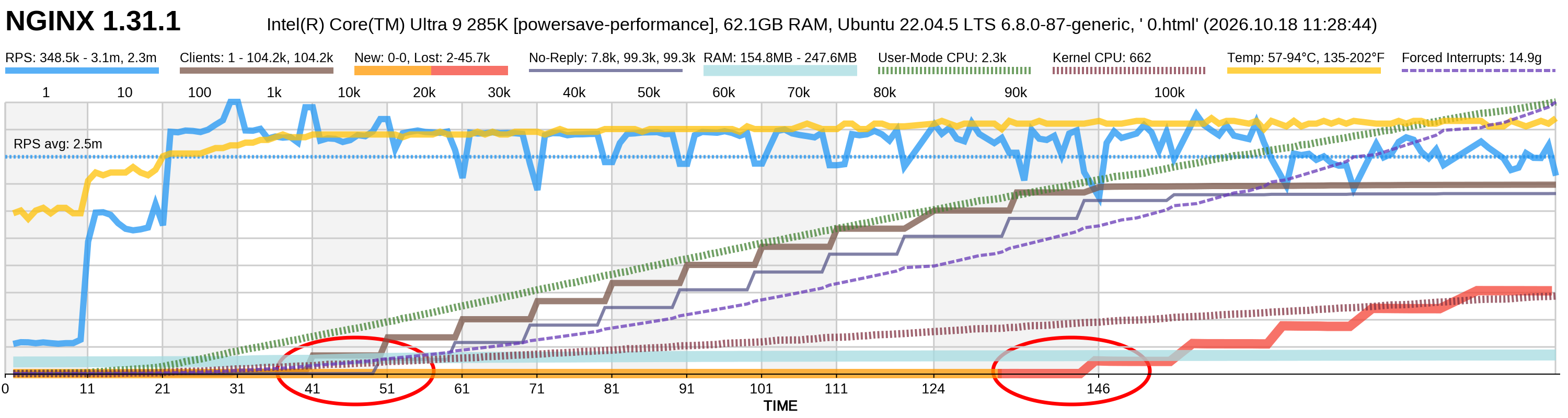
NGINX visibly slows down as concurrency grows, shows tens of thousands of Lost Clients, and its No-Reply count shows that NGINX responds only to a tiny, ever-shrinking number of Connected Clients requests 100/(100k/(100k-99.3k)) = 0.7%. Oops!
This test has been done with the nginx.conf file used for the official F5 wrk benchmark of NGINX (with... 72 clients). F5 provides a 72x wrk -t 1 -c 50 -d 180s 0-byte file test topping at 3m RPS on two DELL machines, each one using 2x 36-Core CPUs and 2x 40 GbE NICs, total: 144 Cores. G-bench gives 3m RPS on 1 PC using 1x 24-Core CPU and localhost where the client and server run together, with a 81-byte request, and a 243-byte reply (not disclosed by F5). We first used the default kernel backlog (/etc/systcl.conf somaxconn = 4096). After NGINX failed to accept clients, we used somaxconn and backlog = 8192, enabled reuseport and set keepalive_timeout = 300s (system defaults and a 5s timeout work for G-WAN but fail for NGINX at 1k+ clients). |
worker_processes auto; # 24 CPU Cores here worker_rlimit_nofile 250000; # 250,000 = 10,416 * 24 pid /var/run/nginx.pid; events { worker_connections 10416; # 250,000 / 24 = 10,416 accept_mutex off; multi_accept on; # off fails @ 90k clients } http { access_log off; include mime.types; default_type application/octet-stream; sendfile on; keepalive_timeout 300s; # 5s works for G-WAN keepalive_requests 1000000; server { listen 80 backlog=8192 reuseport; root /usr/local/nginx/html; } } |
Both errors, Lost Clients and No-Reply are simply ignored by all the benchmark tools made in the past 36 years. Given the number of NGINX (2004) users asking questions and assistance about odd behaviors, call this yet another "accidental coincidence" – if you can.
Enabling the multi_accept (2009) NGINX option, oddly decoupled from reuseport (2015), loses 1m avg RPS but it waves the Lost Clients, and reduces the No-Reply errors (while consuming 14x more RAM, due to the the previously ignored clients):
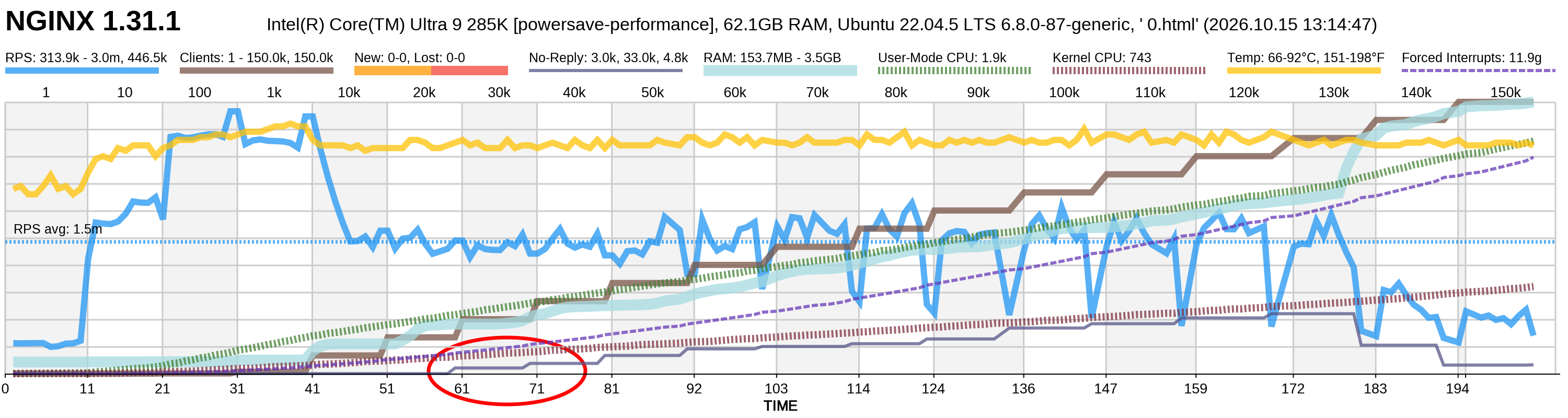
NGINX is then slower, but this is understandable as it handles 45.7k more clients and, instead of failing to pass the 100k clients concurrency step NGINX now completes the test up to 150k clients, albeit with a dramatically falling RPS curve... and still 25.4% (100/(130k/33k)) of No-Reply errors at 130k clients!
In the first chart, the stable RPS curve is misleading: NGINX is supposedly "scaling"... by just ignoring 45.7k Lost Clients while actually processing 0.7% of all Connected Clients requests!
This absolute disaster has been purposely disguised as a desirable achievement by all the benchmark tools: like the 2012 wrk family merely focusing on its deceptive-by-design client RPS and irrelevant client latencies... while ignoring all the other metrics!
Why were wrk and wrk2 so urgently needed in 2012, and why were they the first and only tools excluding client connection times from benchmark scoring? Could this have been due to these prior comparative benchmarks showing NGINX under a less rosy picture?
Until G-bench and its charts, there was no way to easily and quickly detect (and even less quantify) such mysterious problems. The OSes, Web (App) servers vendors, GAFAM, Cloud vendors, hosting companies, universities, and all others, for almost 4 decades, have flatly ignored these deadly issues. Were the trillions invested in these organizations properly allocated? That makes you wonder.
The relation between the RPS, the No-Reply errors, and the RAM is clear on the above G-bench chart. After a single 3-minute G-bench test, you see the (positive and negative) impacts of each NGINX option, saving weeks or even months of investigations.
Again, in this test like in previous tests, G-WAN does massively better than NGINX, and with G-WAN you don't have to go through endless "trial and error" sessions to elucidate the "great mysteries of the universe": G-WAN does not need configuration files!
wrk's severe concurrency gap explains why capacity planning made with wrk -t4 -c200 requires, in the real world, approximately ten times more servers than initially planned: on the Internet, each visitor (thread) sends many connections and requests to a server.
This became worse when Web browsers have disabled HTTP/1.1 pipelining (to promote the false idea that HTTP/2 and HTTP/3, which use pipelining under another name, were faster than HTTP/1.1): instead of 1 connection for N requests, browsers then create 1 connection per request – and many websites have pages using tens if not hundreds of requests sent to a single server!
Capacity planning should rather use wrk -t200 -c200, but unfortunately the wrk family consumes so much RAM that its stops at 30k users with 192 GB RAM, and is too slow to test a server: even NGINX is faster than wrk – so you test the client, not the server.
The F5 official NGINX benchmark states that NGINX does not scale on multicore: "performance peaks at around 8 CPUs; more is not beneficial for throughput‑heavy tasks" but this is already true with 2 CPU Cores depending on the payload size:
|
|
Why are these tables separated in F5's report? And why the Throughput table lacks the 0 KB, 1 KB, 10 KB results published in the RPS table? Further, F5 wrongly documents the "0 KB" reply as a 302 status code (redirection) while it is either a 200 (OK) or 204 (No Contents) status code. Why hide the "0 KB" payload size? | ||||||||||||||||||||||||||||||||||||||||||
For the 100 KB file, and from 2 to 4 CPUs, 88,691 / 62,554 RPS = 1.42 while 45 Gbps / 20 Gbps = 2.25. Oops!
- How can, in the SAME wrk test run, NGINX fail to scale for RPS while scaling++ for the Throughput measurement?
- It can't. This is "creative accounting"... and why the 0 KB, 1 KB, 10 KB results have been removed from the Throughput table.
- This is why these tables are separated and why the "0 KB" payload size has been hidden (via several, redundant, stupid ways).
By hiding its flaws with the treacherous wrk benchmark family, NGINX stole the Apache market shares, became the official world leader by sabotaging, denigrating and censoring a better server, and was sold to F5 for $670m in 2019, a direct wealth transfer from your pension fund to a bunch of private pockets (70% of BlackRock's wealth comes from the U.S., EU, and Swiss pension funds).
Consumers, small businesses, corporations and governments have been betrayed and abused to artificially inflate their deployment and operating expenses (floor space, hardware, energy and water) enriching a very few: the shareholders of the vendors of these resources and of the Clouds, hosting and cyber-security companies where we have all been pushed by ever-growing, unsustainable costs.
All the epoll servers share these by-design defects – hence the explosion of TCP servers falsely claiming to be HTTP servers: by skipping all HTTP parsing (and often disk I/O), they reduce request-processing latency to fake higher HTTP concurrency capacity.
The 2002 epoll design ignores multi-threading: the 2004 EPOLLONESHOT fix (Linux 2.6.2) adds a syscall tax (EPOLL_CTL_MOD) on all events. And the long-overdue 2016 EPOLLEXCLUSIVE fix (Linux 4.5) delivers edge-triggered events to only 1 thread. And the kernel implementation of epoll has exposed users to dozens of vulnerabilities.
epoll claimed to be designed to monitor a "large" long-lived number of connections – when only a "small" number are active at any moment. Yet, this case, "resolved" by NGINX and "benchmarked" by wrk, does not exist! In reality, concurrency is everything:
- Web Apps (telemetry, video-conf, games, quotes) and robots send streams or many pipelined and keep-alived HTTP requests,
- human website visitors using Web browsers fire dozens if not hundreds of short-lived connections, each carrying 1 single request!
- Web servers use small (5 second) connection timeouts to protect themselves against human clients and botnets DDoS attacks.
The defective epoll tried to let single-Core CPUs handle many connections without a thread per connection (like Apache was first doing it)... because 2001 single-Core CPUs were unable to handle many threads, and multi-Core CPUs were mis-exploited.
25 years later, a single CPU Core can handle thousands of threads – and each thread can multiplex thousands of connections, all in usermode: without syscalls and OS patches, with by-design portability and unmatched ease of programming.
On October 15 2026, CVE-2026-98432 is a Linux kernel's TCP/IP stack use after free 10-year old flaw, rated CVSS 9.8/10 as unprivileged opponents can easily compromise any Linux device remotely. The fix, available in early October 2026 was applied as follows:
- Debian Linux ... (1 day) October 16, as an OS update
- Oracle Linux ... (1 day) October 16, as an OS update
- Amazon Linux ... (9 days) October 24, as an OS update
- Red Hat Linux .. (17 days) November 1, as an OS update
- Ubuntu Linux ... (19 days) November 3, as a patch to... apply manually
Once a critical kernel bug is disclosed, it takes less than 1 hour to make a working exploit. As a result, billions of devices have been (and still are) vulnerable today because they are not yet patched (some will never be). Pick your OS supplier carefully:
Use after free (UAF) is trivial to AVOID in kernel/usermode: #define free(p) { void *q = p; p = NULL; os_free(q); }
But the largest and best-funded software vendors do not seem interested in closing their so profitable security holes:
Today NGINX published 4 UAFs as part of its "NGINX2Root" vulnerabilities allowing opponents to take control of the machine by just sending HTTP requests:
| Severity | Description | Common Vulnerabilities and Exposures (CVE) |
| 9.2/10 | Nginx Integer Underflow, heap buffer overflow (RCE) | CVE-2026-123007 |
| 9.2/10 | Nginx Use After Free, remote code execution (RCE) | CVE-2026-123633 |
| 9.2/10 | Nginx Use After Free, remote code execution (RCE) | CVE-2026-123634 |
| 9.2/10 | Nginx Use After Free, remote code execution (RCE) | CVE-2026-121810 |
| 9.2/10 | Nginx Use After Free, remote code execution (RCE) | CVE-2026-113425 |
| 8.7/10 | Nginx Denial of Service, infinite loop (DoS) | CVE-2026-118899 |
| 6.9/10 | Nginx NULL Pointer Dereference, worker process termination (DoS) | CVE-2026-120993 |
| 6.9/10 | Nginx Integer Underflow, worker process termination (DoS) | CVE-2026-125283 |
| 6.9/10 | Nginx Insufficient Validation, routing to privileged backend | CVE-2026-123640 |
| 6.3/10 | Nginx Client Certificate Bypass | CVE-2026-120967 |
Between October and November 2026, the Linux kernel had arround 30 daily vulnerabilities:
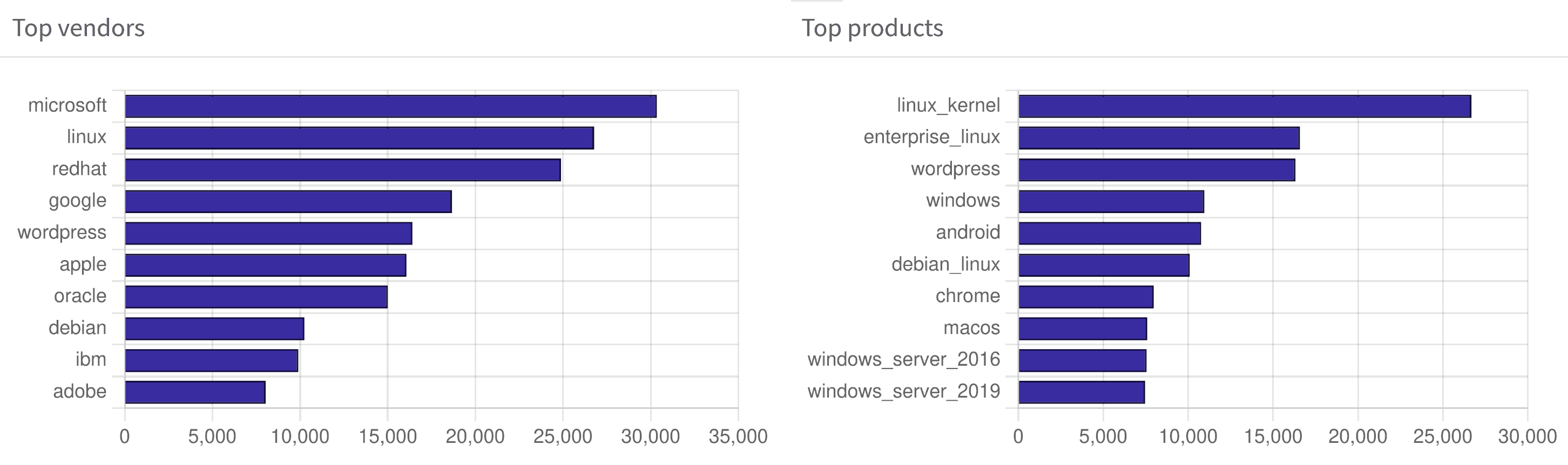
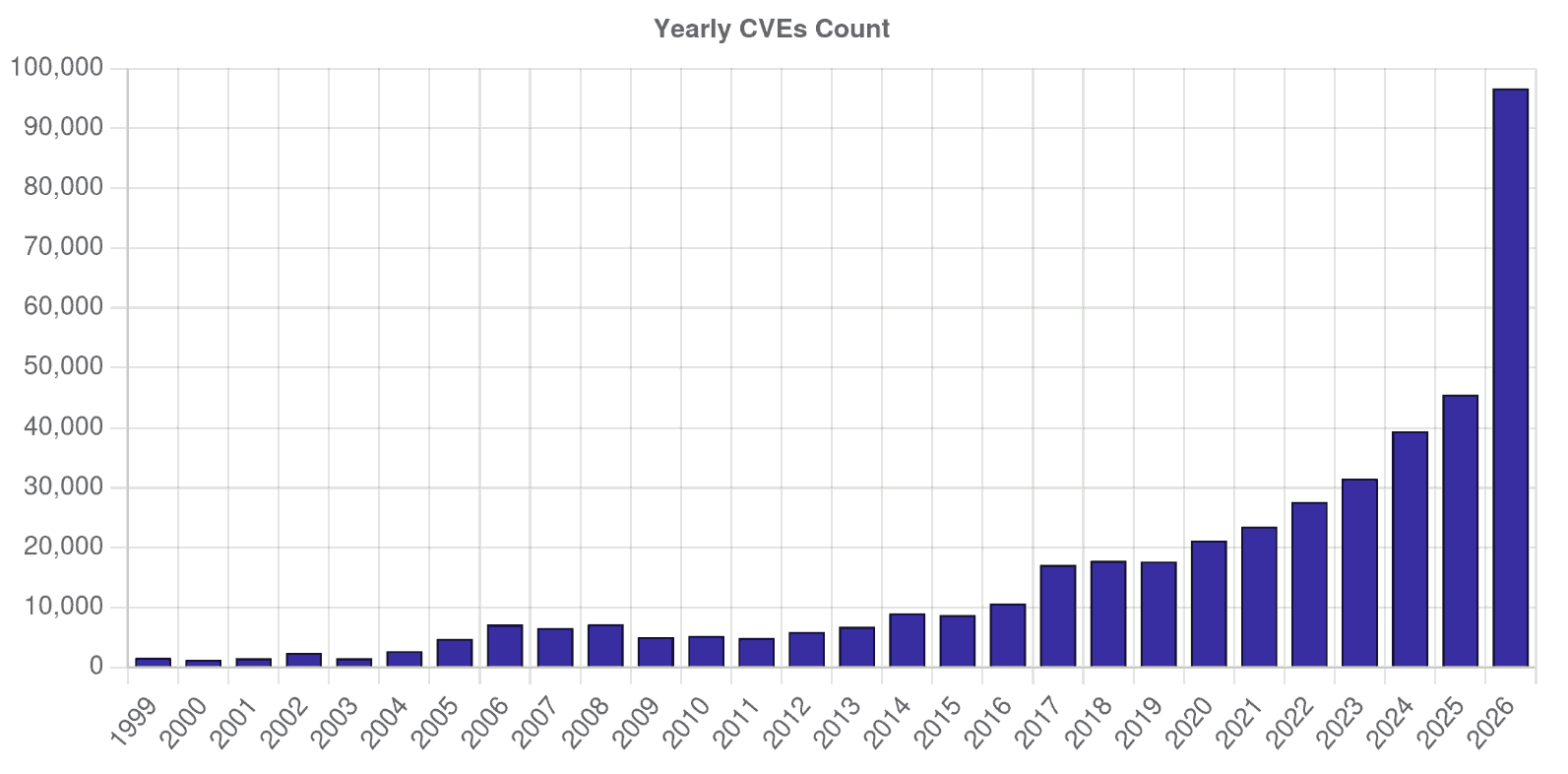
G-WAN.com and the other websites running G-WAN v17+ were not affected. All other Web servers are vulnerable to kernel security holes.
Stop sponsoring the arsonist firefighters – especially with public funding and contracts (the victims' money).
G-WAN is the only high-performance, scalable Web server that can be implemented as an ASIC chip – no need for unfixable, power-hungry SoC (System on Chip) like for NGINX & Co. This is also why I can afford to make G-bench a trustworthy benchmark.
The price of reliability is the pursuit of utmost simplicity. It is a price that the rich find most hard to pay.