Theory vs. Practice
Diagnosis is not the end, but the beginning of practice.
wrk, wrk2 and wrk3, the dire costs of promoting treachery
My two previous blog posts demonstrate that wrk and wrk2 (2012) and wrk3 (2026) all have the same bugs and by-design flaws, so they cannot seriously be used to benchmark servers – yet, they are infinitely celebrated and promoted. How, Why? Cui bono?
 "How NOT to measure latency" Gil Tene at "Unexpected Sources of Inspiration" (USI) of OCTO technology owned by... Accenture. |
On the top of excluding all connections failures & times (to ignore NGINX defects), being atrociously slow (so reporting client rather than server RPS and latencies) and unable to scale (excluding high concurrencies), the wrk family's RPS calculation is wrong: it takes bad start/stop points, inverses start/stop, uses overflowed arithmetic and a broken thread calibration to reduce benchmark time, lets RPS be up to twice larger than the throughput, reports bogus concurrency scores by failing to account for Lost Clients, and... corked pipelined responses! I have documented and fixed 5 of these flaws in April 2026, but since then wrk, wrk2 and wrk3 have preserved all of their bugs. |
Here is the explanation, and why nonsensical, broken technology, despite its unpardonable flaws, is heavily funded and promoted (the wrk family is included in the most important Linux distributions, recommended by the most famous "experts", and used in thousands of Academic "research" papers):
The short story is that "Science" is relevant (useful in real life) when it is not purposely hijacked to tell lies, the lies required by the crooks to steal the masses. I have learned, the hard way, that it is not possible to have a constructive discussion with people acting in bad faith. The only way out is to demonstrate the treachery:
Statistics are relevant when you have a predictable system – which is not the case of the considered defective servers, due to (1) their indigent code (causing chaotic cascade effects that cumulate consequences until black swans surface), and (2) a blind eye to vital metrics (revealing decades-old, often weaponized, shameful secret defects), hence (3) the incoherent storytelling imposed to the masses to hide the root causes of the real problems.
Remember how SLIMalloc has proven that all memory allocators were badly designed – both for performance and security – which has led to SLIMalloc being censored by LinkedIn, Wikipedia and... the U.S. DARPA:
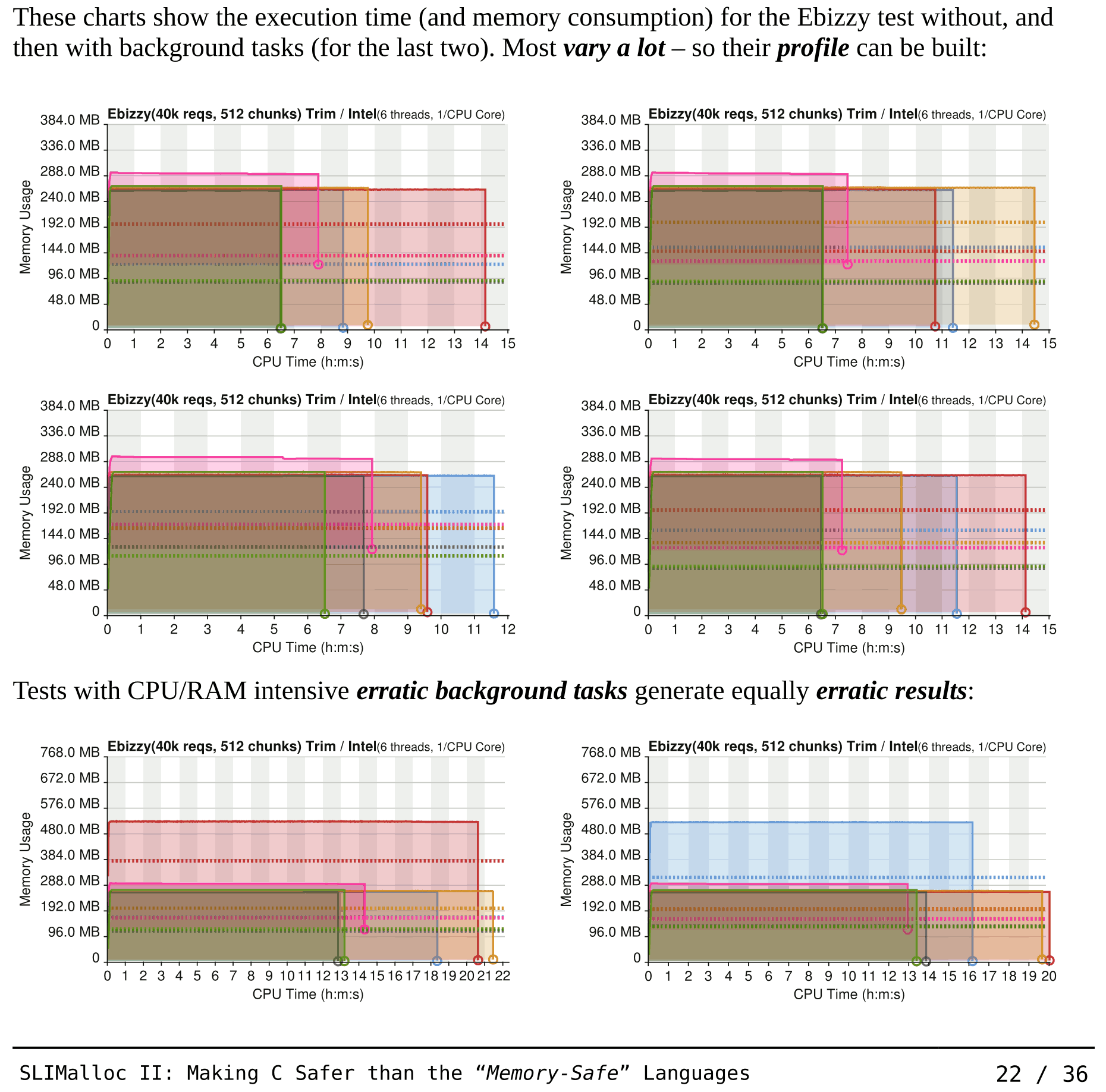
In all the History of Computer Science, SLIMalloc is the only censored memory allocator (probably for threatening the ability for the GAFAM to sell to governments all over the world the backdoors they have injected in their own OS, standard protocols, and Web browsers), tested above in colored charts: GNU LibC, Google, Microsoft, Facebook, pre-allocated, and SLIMalloc the only one to provide "memory-safety", an unprecedented threat against 70 to 90% of all vulnerabilities, according to the NSA:
- https://www.whitehouse.gov/wp-content/uploads/2022/09/M-22-18.pdf
- https://media.defense.gov/2023/Apr/27/2003210083/-1/-1/0/CSI_SOFTWARE_MEMORY_SAFETY_V1.1.PDF
- https://media.defense.gov/2023/Dec/06/2003352724/-1/-1/0/THE-CASE-FOR-MEMORY-SAFE-ROADMAPS-TLP-CLEAR.PDF
- https://www.cisa.gov/sites/default/files/2023-12/CSAC_TAC_Recommendations-Memory-Safety_Final_20231205_508.pdf
- https://bidenwhitehouse.archives.gov/wp-content/uploads/2024/02/Final-ONCD-Technical-Report.pdf
- https://cyberdefensereview.army.mil/Portals/6/Documents/2024-Fall/Yarbrough_Guan_CDRV9N3-Fall-2024.pdf
- https://tsapps.nist.gov/publication/get_pdf.cfm?pub_id=958266
- https://web.mit.edu/ha22286/www/papers/CACM25.pdf
- https://www.ic3.gov/CSA/2025/250212.pdf
In his conference, Gil Tene said: "Always measure the max time, it's the one thing that nobody can ever cheat on you. You can't get wrong statistics for max, right, so always measure it because it's usually your number one warning sign that something is weird."
Wise advice – too bad that Gil Tene did not follow his own recommandation when he wrote wrk2, which has only sabotaged further the already defective wrk, while deceptively calling wrk2 "a more correct version of wrk". That's the gap between theory and practice: to detect the liars, always make sure that what people say (their theory) is matching what they do (their practice).
Gil Tene complains that he has never seen a properly made software system (migrating from Java to C should help), but the SLIMalloc memory allocator does it to the Intel 'ebizzy' benchmark while all others, even the pre-allocated "none" memory allocator, fail to execute in constant time (on the top of being vulnerable by-design, and heavily exploited in the wild):
 ebizzy-libc ... mean: 7.995, median: 7.207, max-min:4.466, variance:1.247309, ave-dev:0.9595, std-dev:1.1168
 ebizzy-mim .... mean: 9.495, median: 8.389, max-min:6.118, variance:2.688220, ave-dev:1.3623, std-dev:1.6396
 ebizzy-tc ..... mean: 9.876, median: 9.201, max-min:5.005, variance:1.466731, ave-dev:0.9565, std-dev:1.2111
 ebizzy-je ..... mean: 6.624, median: 6.490, max-min:1.573, variance:0.127011, ave-dev:0.2172, std-dev:0.3564
 ebizzy-none ... mean: 6.577, median: 6.445, max-min:1.552, variance:0.126568, ave-dev:0.1891, std-dev:0.3558
 ebizzy-slim ... mean: 6.468, median: 6.467, max-min:0.048, variance:0.000062, ave-dev:0.0047, std-dev:0.0079
These untrustworthy, well-funded "experts" publish false news and fake science to disrupt our perception of reality: people are then lost because they don't know where reality begins and ends. And this is the new policy regulating everything. Chaos is the new gold, imposing destructive policies (finance, gender, climate, politics, wars, energy, pandemic, rogue fake AI, etc.) to keep the masses desperately focused on nonsensical, artificially-created urgencies – so we can't build on an ever-moving ground.
We have been tricked, duped, deceived, swindled, hoodwinked, scammed, misled, and manipulated into adopting a set of thoughts and emotions that run counter to our own interests and well-being. It's more than time to say "enough".
The long story is a toxic mix of infinite incompetence and unleashed greed – what else to expect from impostors struggling to hide how they came to power?
Andersen Consulting (1989) changed its name to Accenture on January 1st 2001, after its involvement in the scandals of largest accounting frauds in American history at that time: WorldCom and Enron, among many other "minor" cases. Quite a reference!
More recently, Accenture (2026 revenue: US$74.18 BN) has faced multiple legal and regulatory issues, including fraudulent billing and kickbacks on U.S. government IT contracts in 2011 and misleading federal agencies about cloud platform security compliance in 2025.
As a taxpayer, the fact that such serial criminals always escape jailtime and are not excluded from all public contracts tells more about our politicians than I would like to know. But if we do nothing, things will only get worse: rewarding crime generates more crime!
So, now we can understand the nature of the pursued agenda, and the illegal means used to enforce it, it is much easier to explain the cognitive dissonance:
- wrk by Will Glozer claimed to be fast, yet was "not correct" said Gil Tene who made wrk2.
- wrk2 added more unpardonable parallelism bugs to wrk and introduced "coordinated omission".
- wrk3, made by Istvan Szukacs, claims to better handle "coordinated omission" than wrk2.
wrk was already treacherous by (for the first time for a Web benchmark) establishing all connections upfront before sending the first HTTP requests – to hide the NGINX gazillions of Lost Clients, on the top of being so slow that it is measuring its own client RPS and latencies rather than the "tested" server performance (done to artificially reduce the scores of all faster servers).
wrk2 pushed treachery further by adding 4 unpardonable parallelism programming errors (without fixing the wrk bugs), none of them plausibly accidental, while introducing the distraction ("look here", but "not there") of "coordinated omission". Istvan Szukacs, Prof. at the Frankfurt School of Finance & Management explains it as follows:
- "If you plan to send 1000 RPS and the server stalls for 1 second, a traditional load generator measures 0 requests during that second (it was waiting)."
- "wrk3 correctly reports that 1000 requests experienced 1+ second latency – because that's what real users would have seen."
This description is much shorter and less confusing than the long and painfully convoluted definition given by Gil Tene... but remember that the tools written by these three experts (1) flatly ignore gazillions of Lost Clients, (2) rely on overflowed arithmetic to calculate (bogus) RPS, and (3) have still not fixed their precious mess... even after I did it for them, 6 month ago.
A well-designed benchmark tool (or server) should never, ever be able "to block for 1 second": both have multiple threads – and the only safe way to measure RPS gaps and variations is to use a global atomic RPS variable, and a per-thread RPS count (so you can compare them, and check the RPS distribution per thread and per connection – something that all the benchmarks... don't do).
Worse, the wrk2 idea of throwing client requests at a specified, constant rate to a server prevents from finding the server capacity (and gaps): beyond the wrk agonizing fat and pulmonary insufficiency, a client applying a command-line specified tempo is even more certainly the bottleneck, so, again, you end up testing the malformed (asthmatic, obese) benchmark client, and not the server.
And if you believe that just raising the fixed RPS rate in consecutive wrk2 tests will let you find the server bottleneck then you are hallucinating: you would have to do it for all the plausible fixed rates (ranging in the millions) with 150k series of 10-second tests (repeated for every single concurrency step from 1 to 150k clients) – until you eventually reach a limit, or at least a solid trend, like the ever-growing Lost Clients affecting NGINX & Co.
For the record, 1 single serie of 150k tests would take: 10 x 150k = 1.5m seconds = 17 days and 8 hours (with 3 teams of engineers relaying themselves every 8 hours to work 24/24h). And you would have to run this million times. At such a pace, a lifetime will not be enough to make a diagnosis, and even less any progress... which very well seems to be the pursued goal of all the benchmarks authors.
So, obviously the whole (proposed) exercise is vain – and that's most probably its only reason to exist, and to be so well funded and promoted by billionaire companies (their untaxed revenue, coming from governments issuing public debt, do not increase productivity, they only increase the burden of paying back the ever-growing public debt interests – a task left to the impoverished populations).
The proper way to test a server is simply to have many client threads (many independent concurrent users – not just a very few epoll threads sending requests serially, one after another, after they got server replies) send as many RPS as possible during 3+ minutes while periodically raising the concurrency and checking how many (requests and clients) a server is able to answer – just like in real life!
- If you get a delay, or a limit, at least you know at which concurrency level there's a problem (no need to do gazillions of tests to explore each concurrency separately).
- If, during this process, your benchmark bothers to collect vital server and client metrics (an exotic practice if you consider today's benchmarks), then you will be able to identify and explain many things, including the server limits.
That's what G-bench does, because all other benchmarks are clearly designed (and funded) to deceive by... hiding the facts:
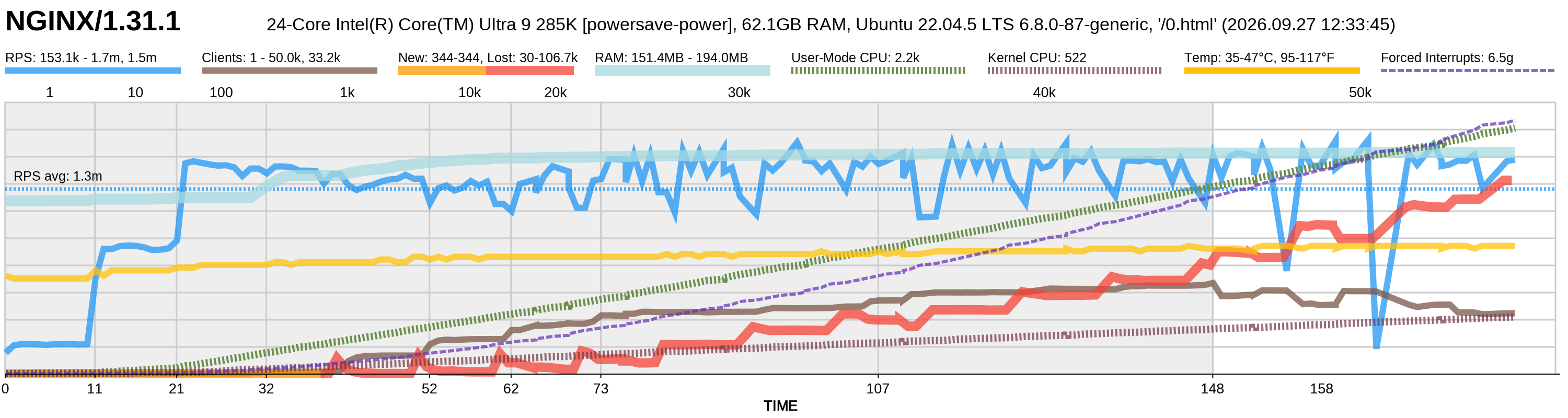
Remember the 2015 claim that "NGINX supports 1 million concurrent clients"? Dead ones, sure (25 lines of C code can do it), but not active clients – even on a 2022 Linux OS, powerful 2025 machine... and a zero-byte HTML file.
Every single time, the trick is the same: "look here" (how to pick your next politician, nails varnish color – or gender), so you won't ever have enough time to "look there" (how they rob your money – THE thing that really matters). And, like the famous illusionists, they add fire, explosions, smoke & mirrors, funny pictures, a girl or two in bikinis – to distract you even further.
So, instead of being obsessed by latencies percentiles (that the wrk family is not even able to measure), look at the fundamentals: how many clients are you servicing... in reality? At which speed (RPS)? With what level of security?
How is it possible for decades-old "security layers" (like SSL or TLS) to inject thousands of security vulnerabilities in an otherwise safe application? Or for NGINX to have 20+ vulnerabilities per month(!) in 2026? Why do we have to suffer constant cognitive dissonance (aka "plain lies")?
Why university researchers, journalists and security "experts" don't notice such an obvious betrayal of the common-good? Why ubiquitous backdoors (compromising the security of banking, e-commerce, e-business, e-administration, industrial systems, voting machines, routers, firewalls, Web applications, VPNs, etc.) are more important to our political authorities than the security of our critical infrastructure? Why there's no public debate allowed on these crucial questions? Cui bono?
Interestingly, Edward Snowden has written an article about it. And, while his diagnosis about the industry selling backdoors is correct, he makes very strange assertions for such a security expert:
- "aging programming languages that have long been regarded as unsafe"
- "happy to write code in programming languages that we know are unsafe"
- "choosing a safer language a crucial protection"
- "if you want to see Microsoft have a heart attack, talk about the idea of defining legal liability for bad code in a commercial product"
- "Google said 70% of serious bugs in its Chrome Browser are related to memory safety. These can be reduced by using safer programming languages."
Ahem. For (1),(2),(3) the GAFAM inject and market their own backdoors in their own products, so calling for using "safer languages" [made by the GAFAM] is just giving them a way to prevent all others from patching or disabling the backdoors – and therefore a total monopoly on the backdoors market. One more: they already have the OS, Web browsers, Clouds, majority of investments, public contracts, fiscal and legal leniency, etc.
And, there's a simple way to resolve 70-90% of all vulnerabilities (70% for Google Chrome, 90% for Google Android): SLIMalloc (2023) accelerates C while making C safer than Rust (because, unlike Rust, SLIMalloc also protects against third-party "unsafe" code, and does not force you to write "unsafe" code to deliver speed). SLIMalloc has immediately been censored by LinkedIn, Wikipedia and... the U.S. DARPA (in charge by two U.S. Presidents to resolve the "memory-safety" problem).
(4) Microsoft publicly suggested (a decade ago) to fine all software vendors million dollars by vulnerability – knowing that a very few could easily pay these fines because the sales of their own vulnerabilities generate a much (much) higher revenue. The pursued goal was to legally impose a scheme that would give the GAFAM a monopoly on the manufacturing and sales of all vulnerabilities (and progressively on all software programs since software vendors are wrongly held responsible for OS backdoors!). Charging 10% of their global annual revenue per vulnerability would be a much better deterrent... but Ed does not enter into such considerations.
(5) Google, which claims to do everything it can for the security of its users, is heavily (and for decades) injecting UAF (use-after-free) in Chrome, its Web browser, while this issue is absolutely trivial to resolve for any decent C/C++ programmer: patch the LibC with a macro #define free(p) { void *q = p; p = NULL; libc_free(q); }. Why do you think the GAFAM don't do it? Aren't their $10TN of market capitalization and 1m engineers enough if I did it in a mere 3 seconds?
I was not expecting to see Ed doing shameless marketing for the GAFAM Rust programming language... which is unsafe by-design since its users have to bypass its "security" (1) to use OS syscalls, and (2) by using their own "unsafe" code to deliver decent speed (yet still inferior to the "aging" C which is the "Lego" used to make all the other languages and OSes).
Wake-up Ed, all programming languages can transparently be made "memory-safe" with SLIMalloc – hence its censorship by... the GAFAM.
If you are wondering why (1) life gets more expensive, (2) jobs get more scarce and less rewarding, (3) the number of brainless billionaires is exploding – look no further: this is "the unstoppable march of progress" where our governments have to pay ever-increasing bills (and debt) to the criminal organizations promoting inefficiency and gratuitous expenses in public administrations, wars, healthcare, the Web and the Cloud – the polite way to describe an ever-growing "racket".
Remove the toxic filth from our society, and we will once again have a thriving economy and a promising future for our children.