Theory vs. Practice
Diagnosis is not the end, but the beginning of practice.
G-bench meters performance & correctness in a jungle of systemic, organized fraud
Previously, we have seen why wrk and wrk2 are totally bogus, but I have discovered since then that the "creative accounting" is much worse, and never detected – because benchmarks and servers team up to deliver ubiquitous "coordinated omission":
Since wrk and wrk2 (2012) RPS calculation is wrong: they take bad start/stop points, inverse start/stop, use overflowed arithmetic and a broken thread calibration to reduce benchmark time. wrk2-fix has fixed these issues but it inherits a wrk and wrk2 bug that lets RPS be up to twice larger than the throughput, see Actix, Fiber and GenHTTP vs NGINX below:
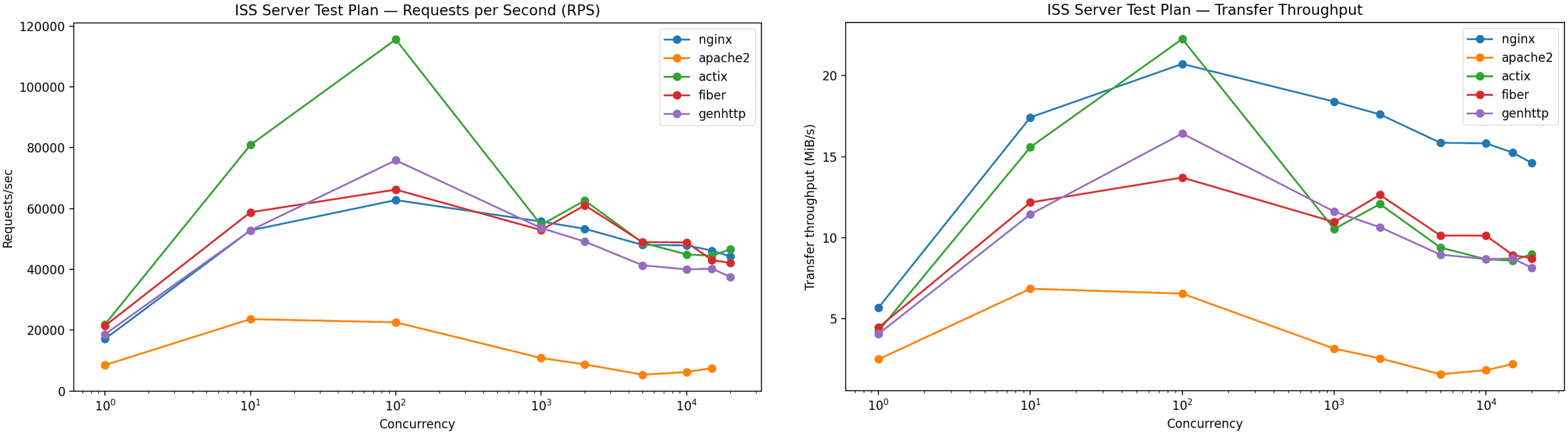
Actix, Fiber and GenHTTP are not fast: they are defective. And the only reason why they shine in the treacherous wrk and wrk2 tests is because these "benchmarks" don't even check if a server behaves correctly. Why bother, rigth?
You can't trust the authors of these purposedly broken tools and servers: they constantly lie, for decades, and don't correct their works when warned about their deadly defects – because spreading confusion and chaos with smoke & mirrors is how they rob all others:
The investors and companies behind today's AI bubble are serious, right? Leaked (confidential) Anthropic IPO prospectus shows crazy red ink numbers: $42BN net loss, $518BN in unfunded spending commitments, and $20BN in cash! Almost all courtesy of your pension funds, and with empty claims of academic breakthroughs (in an attempt to divert the attention from their abysmal revenue gap):
- Stephen Miller, a mathematician at New York's Yeshiva University, states that OpenAI has effectively plagiarized his own research.
- Tristan Buckmaster, a mathematics professor at New York University's Courant Institute School of Mathematics, Computing, and Data Science, states that when he planned to go public about his finding an OpenAI employee asked him "Why would you ruin your career?".
This aggressive community of storytellers does "whatever it takes" to bend reality to its wishes. As you will soon discover here:
Most Web servers ignore many new client connections, yet all benchmarks incorrectly claim the target concurrency was met!
Further, many servers are presented as "HTTP servers" while they: (1) skip the HTTP protocol, merely sending fixed answers to all requests without request-parsing and response-building, (2) skip all memory management, and (3) don't even read files from disks!
Obviously, doing nothing is faster than doing a lot of things, and that's why TCP servers are fraudulently presented as top HTTP server performers by benchmark platforms like TechEmpower or Http-Arena, clearly designed to promote junk. Cui bono?
Increasingly bluring the lines of reality is a twisted tactic, and they publicly brag about it for decades – not only for Computer Science:
[People] believe that solutions emerge from your judicious study of discernible reality. [...] That's not the way the world really works anymore. We're an empire now, and when we act, we create our own reality. And while you're studying that reality –judiciously, as you will– we'll act again, creating other new realities, which you can study too, and that's how things will sort out. We're history's actors... and you, all of you, will be left to just study what we do.
Chaos is the new gold, imposing destructive policies (finance, gender, climate, politics, wars, energy, pandemic, rogue fake AI, etc.) to keep the masses desperately focused on nonsensical, artificially-created urgencies – so we can't build on an ever-moving ground.
In contrast, G-bench provides many cross-checked metrics, per-second results, 10-second concurrency step summaries, and ending (automatically rescaled) SVG charts showing how serious (or defective) the tested server is... on much higher concurrencies: 150k true clients on a 16 GB RAM PC – while wrk2-fix -t30k -c30k stops on a 192 GB RAM PC... and wrk2 -t10k -c10k now crashes!
G-bench reveals never-seen-before insights, here for NGINX tested with its 2016 official F5 benchmark nginx.conf file, then with the 2015 reuseport NGINX 1.9.1 option. This test cannot reach 150k concurrent clients like for G-WAN: it stops because NGINX fails to complete the 50k concurrency step (without reuseport), and then the 100k concurrency step (with reuseport):
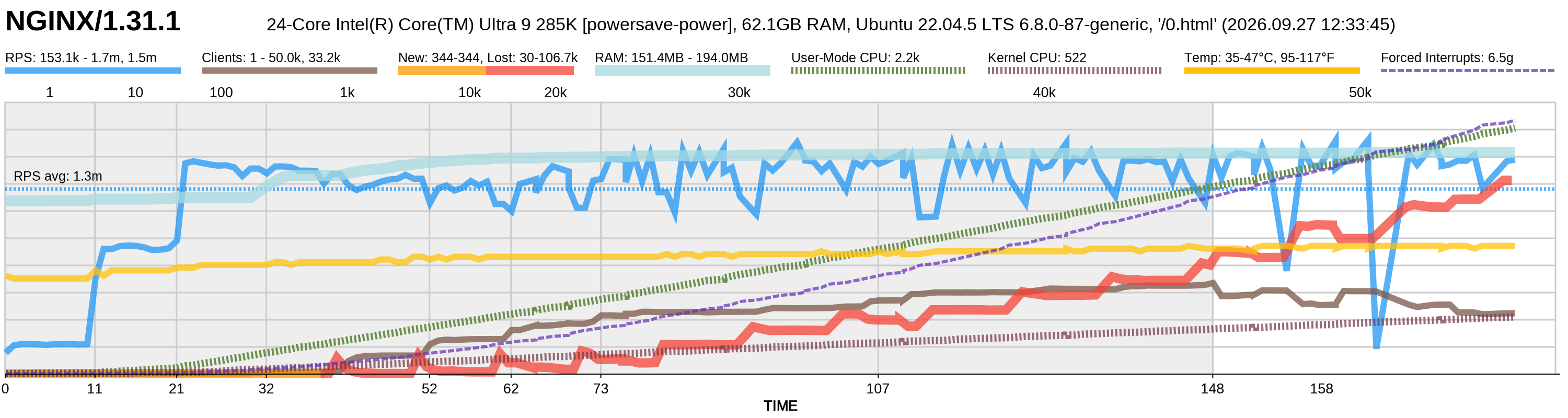
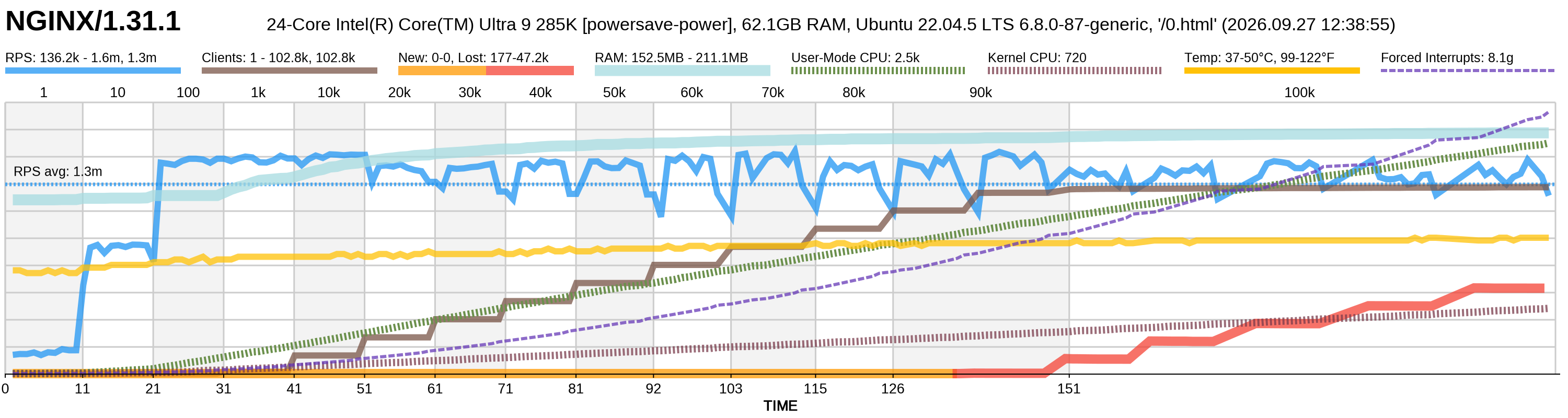
Above, while the RPS avg stays the same, reuseport avoids an early catastrophic NGINX count of Lost Clients starting at 1k clients! The official F5 tests don't to do it (in 2016 or 2017), nor they enlarge the kernel somaxconn and NGINX's backlog for HTTP because wrk has been designed to prevent you from seeing if a busy server can accept new clients quickly, or even if it accepts all of them!
Even more revealing, in 2012 wrk was the first tool to exclude clients connection time from all tests (sending requests after all client connections were established) to fuel purposely misleading, undocumented claims such as this 2015 false advertising published everywhere on the Web: "nginx supports 1m concurrent clients".
On the Internet, new client connections immediately bring (at least) one HTTP request (several can be pipelined) – so there's no way (in real life) for a server to stay idle while stacking 1m clients: already, with a couple of connections, a server is not idle. wrk and wrk2 have been created in 2012 to benchmark a use-case that does not exist – just to pretend that NGINX was much better than it was in reality.
Before Linux kernel 4.18 (2018), somaxconn was a 16-bit value limited to 65,535 (216 - 1). With kernel 4.18 somaxconn is a 32-bit value that can be set up to 2,147,483,647 ((232 / 2) - 1). Since Linux kernel 5.4 (2019), the default somaxconn value went from 128 to 4096.
As enlarging somaxconn increases latencies and the Lost Clients due to (requestless Clients, Slowloris, etc.) constant, invisible attacks, a server able to accept new clients quickly is vital. That's the only reliable way to avoid constantly losing gazillions of new website visitors.
NGINX does not know when it starts losing clients: you must monitor the system with external tools to detect this issue, reconfigure the system with sysctl (persistent changes) or /proc (temporary changes) and reconfigure and restart NGINX (with an mix of more workers, connections, and a higher listening backlog), in the hope that it will finally cope with the upcoming traffic – that is, every time the network load has changed (and up to the threshold where NGINX fails completely).
Set these options too high for the current traffic load, and the problem will (silently) get worse! The backlog and reuseport NGINX options may help, but this server has limits that aren't lifted by even adding more CPU Cores. If a NGINX worker is above 80% CPU usage, then raising the backlog deepens the queue – without preventing clients drops:
The F5 official NGINX benchmark states that "Resource contention eventually outweighs the positive effect of adding more CPUs" and that "there is a slight decrease in performance (here, in CPS) when we increase the number of CPUs from 32 to 36. Oops!
False advertising is illegal in all countries. Especially when deceit is used to massively rob consumers forced (by outright fraud and anti-competitive practices excluding better Web servers) to buy more hardware, electricity (or hosted servers and Cloud instances) than needed, while still being vulnerable.
NGINX obviously still can't "support 1m concurrent clients" today – more than a decade later, even on a more powerful machine. Crooks lie when they believe that they are safe as nobody can contradict them. Today, thanks to G-bench, everybody can see why this NGINX claim was just an empty promise abusing people's ignorance... actively maintained by the absence of any serious benchmark tool.
And, incredibly, among the accepted clients, there's no accounting of the ones never actually getting a reply from a server!
G-bench lets you see the activity of the (really) Connected Clients, RPS, UserMode CPU and Kernel CPU, RAM usage, the Forced Interrupts and the resulting CPU Temperature, but also the New Clients (connections waiting to be accepted) and the Lost Clients (connections ignored by a server, because it was too busy to prevent the kernel backlog from overflowing). I will also add the per concurrency-step No-Reply count of clients not getting the expected reply number or size.
G-bench lets you see at first glance by how much a server (version, configuration, application, or vendor) is faster, parcimonious and more reliable than another, by just looking at comparison charts (with harmonized scales) showing many metrics!
So, yes, it takes time for G-WAN to fill the technical and performance gaps cumulated by decades of well-funded, infinitely treacherous market players – and doing so requires G-bench, a new, fast and trustworthy benchmark. There's no substitute to doing the right thing, step by step, because nobody else (not even our universities, the "Temple of Knowledge") has ever started doing it.
People's beliefs and convictions are almost always gotten at second hand, and without examination.
With G-bench, false advertizing is detected by insightful, reproducible, objective metrics that show why G-WAN is a better value proposition than NGINX & Co. – the mediocre cohorts that the Wikipedia editors find so "notable" (worth mentioning) that they enjoy tens or hundreds of references[ 1 ],[ 2 ],[ 3 ] while G-WAN is censored everywhere since 2009.
When undue promotion goes to the well-funded products (receiving tens to hundreds of million EUR/USD in EU and US public grants, subsidies and contracts) merely "notable" for their delinquent management, and their passion to deliver abysmal usability, performance and safety, the main victim is the consumer, deprived from the best technology to be forced to buy unnecessary hardware, electricity and "security" tools or services – for... artificially-created problems.
PS: on April 14 2026, I initially gave wrk2-fix a simpler name: wrk3. But since then (at the time I checked before using this name) a Github project called "wrk3" appeared, claiming to be authored on April 8 2026, that is, before 'my wrk3'. Unsurprisingly, the Github 'wrk3' author, Istvan Szukacs from Budapest in Hungary, Europe (Istvan Szukacs on LinkedIn), Prof. at the Frankfurt School of Finance & Management (not an obvious fit for the task), and despite using the Claude AI to assist him in this wrk2 rewrite, did not detect any of the 4 unpardonable parallelism programming errors that I have documented and fixed in wrk2 with many "GPG"-prefixed comments in the wrk2-fix source code, modifications which are detailled in my April blog post.